How to Start a Matchmaking Business in India
Thinking of starting a marriage bureau or matchmaking service? Here is a simple, step-by-step guide on what you need, how to find clients and how to get your first matches.
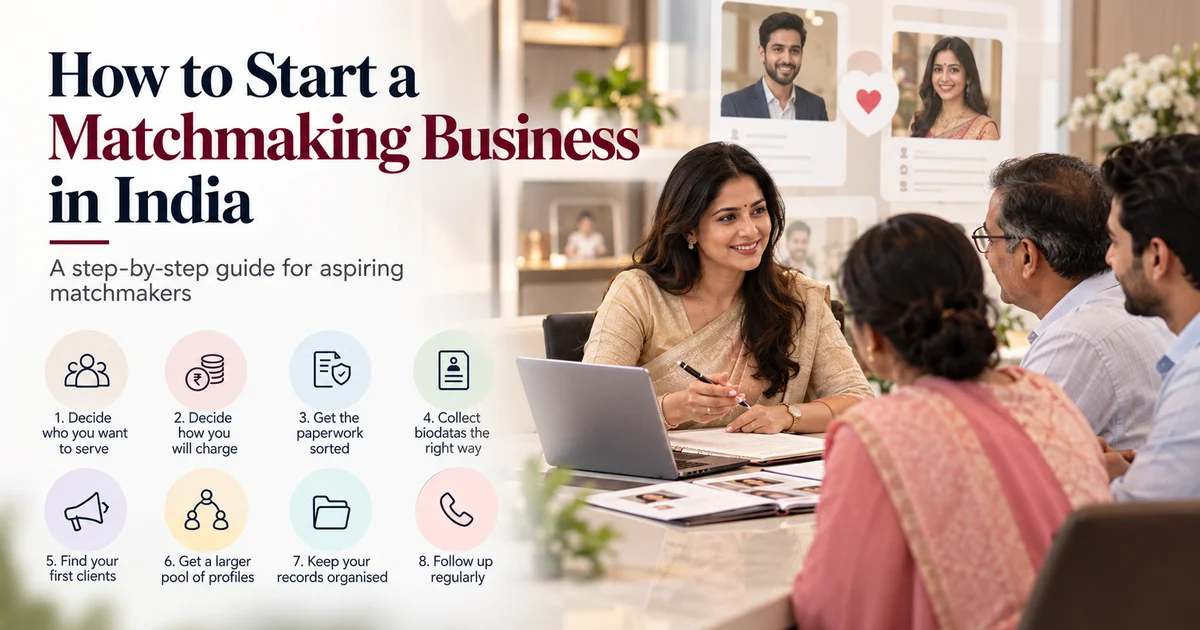
A lot of people get into matchmaking without planning to. A relative asks you to find a match for their son. Then a neighbour asks. Then someone from your community calls because they heard you are good at this. After a while you realise you are already doing the work. You just haven't called it a business yet.
If that sounds like you, or if you are starting from zero, this guide walks you through the basics of starting a matchmaking business in India.
1. Decide who you want to serve
You don't have to serve everyone. In fact, it is easier to start with a group you already know well. This could be:
- Your own community or caste
- Families in your city or district
- A profession, like doctors, engineers or government employees
- Second marriages, NRI families, or any other group that needs extra care
When you know the families you are working with, you understand what they are looking for. You know the questions parents will ask. That trust is the biggest asset you have when you start.
2. Decide how you will charge
Most matchmakers in India use one of these models, or a mix:
- Registration fee: a one-time fee when a family signs up with you.
- Success fee: a fee when the marriage is fixed.
- Packages: a fixed fee for a set period, like 3 or 6 months of active search.
There is no single right answer. Talk to a few families and see what they are comfortable with. Write your fees down clearly and share them before you start working with a client. Clear fees avoid a lot of awkward conversations later.
3. Get the paperwork sorted
You can start small, but it helps to look professional from day one. Think about:
- Registering your business name (as a sole proprietor, partnership, this is simple)
- A separate bank account or UPI ID for business payments
- GST registration if your income crosses the limit. Well in begining GST number is not mandatory but its helps you to verify your business on various social media platforms and shows a trust mark in your business
- A simple written agreement that says what you will do, what you charge and how you handle the family's personal details
If you are unsure about tax or registration, speak to a local CA. It is a small cost and it saves trouble later.
4. Collect biodatas the right way
Your biodatas are your stock. A good biodata has the basics (age, height, education, job, family details, religion and caste) plus recent photos. It also has a short note on what kind of partner the person wants.
Always ask for permission before you share someone's biodata or photos with another family. Families trust you with private information. Protecting it is part of your job.
5. Find your first clients
Your first clients will almost always come from people who already know you. Some simple ways to get started:
- Tell relatives, friends and community groups that you are now doing this properly
- Talk to temple, gurudwara, mosque or community hall committees
- Create a WhatsApp Business account with your rates and contact details
- Make a simple Google Business Profile so people in your area can find you
Word of mouth is still the strongest source of clients in this business. One happy family can send you five more.
6. Get enough profiles to match from
This is where most new matchmakers struggle. You may have 20 or 30 clients, but that is not enough to find good matches for all of them. A girl from your list may not have a suitable boy in your list at all.
Many matchmakers solve this by working with other bureaus, sharing biodatas over WhatsApp. It works, but it gets messy fast. You lose track of who sent what, and old biodatas keep circulating long after someone is already married.
A better option is to join a platform where your clients can be matched with a larger pool of profiles. On WedMeFy, for example, matchmakers add their clients to one shared network, and each client gets matches from members who registered on their own and from other matchmakers' clients.
7. Keep your records organised from the start
It is tempting to manage everything in a diary and your phone gallery. That is fine for the first ten clients. After that, it becomes hard to remember who you showed to whom, who is waiting for a reply, and who has already found a match.
Keep one place where every client's biodata, photos and current status are stored. It can be a spreadsheet or matchmaking software. What matters is that you can find anything in under a minute when a parent calls.
8. Follow up, and keep following up
Most rishtas don't fail because the match was wrong. They stall because nobody followed up. A family said "we will think about it" and nobody called back.
Set a simple habit: every match you suggest gets a follow-up call within a few days. Families notice this, and it is one of the main reasons they recommend a matchmaker to others.
A quick checklist
- Pick the community or group you want to serve
- Fix your fees and write them down
- Register your business name and open a business account
- Prepare a simple client agreement
- Collect biodatas with permission
- Find a way to get a bigger pool of profiles
- Keep all client records in one place
- Follow up on every match
Starting a matchmaking business doesn't need a big office or a big budget. It needs trust, good records and a lot of follow-up. Start small, do it properly, and let your happy families do the marketing for you.
Written by
WedMeFy Team